PBS vs DPBS vs HBSS: Which Buffer Should You Use?
June 15, 2025 · MakeSolution Team
Introduction
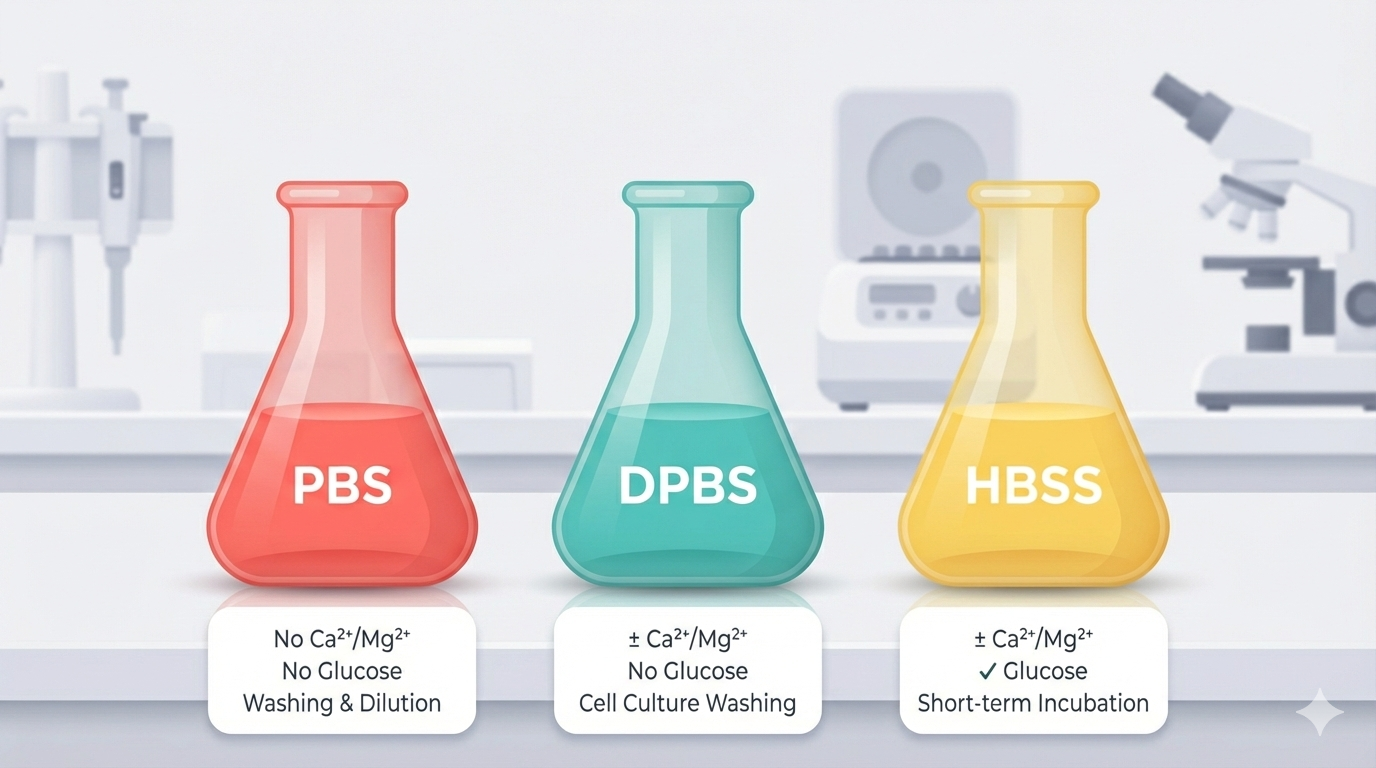
Choosing the right buffer is one of those deceptively simple decisions that can make or break an experiment. PBS, DPBS, and HBSS are the three most common isotonic buffers in cell biology labs, yet researchers often use them interchangeably — sometimes without realizing the consequences.
This guide breaks down the composition, purpose, and practical considerations for each buffer so you can pick the right one every time.
Quick Comparison Table
| Property | PBS | DPBS | HBSS |
|---|---|---|---|
| Full name | Phosphate Buffered Saline | Dulbecco's Phosphate Buffered Saline | Hank's Balanced Salt Solution |
| pH | 7.4 | 7.4 | 7.0–7.4 |
| Osmolarity | ~280 mOsm | ~280 mOsm | ~290 mOsm |
| Ca²⁺ | ✗ | Optional (0.9 mM) | Optional (1.3 mM) |
| Mg²⁺ | ✗ | Optional (0.5 mM) | Optional (0.9 mM) |
| Glucose | ✗ | ✗ | ✓ (5.6 mM) |
| Bicarbonate | ✗ | ✗ | ✓ (4.2 mM) |
| Buffering | Phosphate only | Phosphate only | Phosphate + Bicarbonate |
| Best for | Washing, dilution | Cell culture washing | Short-term cell incubation |
PBS (Phosphate Buffered Saline)
Composition
Standard 1× PBS contains:
- NaCl — 137 mM (ionic strength)
- KCl — 2.7 mM (ionic strength)
- Na₂HPO₄ — 10 mM (buffering)
- KH₂PO₄ — 1.8 mM (buffering)
Key Properties
PBS is the simplest of the three buffers. It maintains physiological pH (7.4) and osmolarity (~280 mOsm/L) using only phosphate salts and sodium/potassium chloride. No divalent cations, no glucose, no bicarbonate.
When to Use PBS
- General washing of cells, tissues, or blots
- Diluting antibodies for Western blot, ELISA, or immunostaining
- Resuspending cell pellets for analysis (not culture)
- Immunohistochemistry and immunofluorescence rinses
- Any situation where you need an isotonic buffer and divalent cations would interfere
When NOT to Use PBS
- Cell culture washing before trypsinization — PBS works, but if your cells are sensitive, the lack of Ca²⁺/Mg²⁺ may cause premature detachment
- Protocols requiring glucose for metabolic support
- Long-term cell incubation outside a CO₂ incubator (no buffering against CO₂ loss)
DPBS (Dulbecco's Phosphate Buffered Saline)
Composition
DPBS comes in two formulations:
DPBS without Ca²⁺/Mg²⁺:
- NaCl — 137 mM
- KCl — 2.7 mM
- Na₂HPO₄ — 8.1 mM
- KH₂PO₄ — 1.5 mM
DPBS with Ca²⁺/Mg²⁺:
- All of the above, plus:
- CaCl₂ — 0.9 mM
- MgCl₂ — 0.5 mM
Key Properties
DPBS was developed by Renato Dulbecco as a modification of PBS for use with cell cultures. The phosphate concentrations are slightly lower than in standard PBS, and the "with Ca²⁺/Mg²⁺" version adds divalent cations that are important for cell adhesion and signaling.
When to Use DPBS
- Cell culture washing — DPBS (–Ca²⁺/–Mg²⁺) is the standard wash before trypsinization, because removing divalent cations helps trypsin detach cells
- Cell culture washing where adhesion matters — DPBS (+Ca²⁺/+Mg²⁺) when you want to wash without detaching adherent cells
- Live-cell experiments where you need a cleaner buffer than PBS but don't need glucose
- Dissociation protocols — Ca²⁺-free DPBS is preferred over PBS in many cell dissociation protocols
DPBS (–) vs DPBS (+): The Critical Difference
This is the most common source of confusion:
- DPBS (–Ca²⁺/–Mg²⁺): Promotes cell detachment. Use before trypsinization or enzymatic dissociation.
- DPBS (+Ca²⁺/+Mg²⁺): Supports cell adhesion. Use for gentle washing when you want cells to stay attached.
Always check your protocol. Using the wrong variant can ruin your experiment.
HBSS (Hank's Balanced Salt Solution)
Composition
HBSS is the most complex of the three:
- NaCl — 137 mM
- KCl — 5.4 mM
- Na₂HPO₄ — 0.3 mM
- KH₂PO₄ — 0.4 mM
- NaHCO₃ — 4.2 mM
- D-Glucose — 5.6 mM
- CaCl₂ — 1.3 mM (optional)
- MgSO₄ — 0.8 mM (optional)
Key Properties
HBSS was designed by John Hanks in 1940 as a more physiologically complete medium. It includes glucose for metabolic energy and bicarbonate for pH buffering in a CO₂ environment. This makes it suitable for short-term incubations where cells need more than just osmotic support.
When to Use HBSS
- Short-term cell incubation outside complete media (up to a few hours)
- Cell-based assays that require metabolically active cells (e.g., uptake assays, calcium imaging)
- Tissue dissociation and primary cell isolation
- Organ perfusion and tissue transport from surgery to lab
- Calcium imaging — HBSS provides a good baseline for dye-loading and imaging
When NOT to Use HBSS
- Simple washing — HBSS is overkill; use PBS or DPBS instead
- Long-term culture — HBSS lacks amino acids, vitamins, and serum; it cannot replace complete media
- Autoclaving — The glucose in HBSS can caramelize; use sterile filtration instead
Decision Guide: Which Buffer to Choose
Start with these questions:
- Are you just washing or diluting? → PBS (simplest, cheapest, most versatile)
- Are you washing cultured cells before trypsinization? → DPBS (–Ca²⁺/–Mg²⁺)
- Are you washing cultured cells but need them to stay attached? → DPBS (+Ca²⁺/+Mg²⁺)
- Do your cells need metabolic support for the next few hours? → HBSS
- Are you doing calcium imaging or ion-sensitive assays? → HBSS (with or without Ca²⁺ depending on assay)
- Are you isolating primary cells or dissociating tissue? → HBSS (with glucose for cell viability)
Common Protocol-Buffer Pairings
| Protocol | Recommended Buffer |
|---|---|
| Western blot washing | PBS or PBST |
| ELISA washing | PBS or PBST |
| Immunofluorescence wash | PBS |
| Cell culture wash (pre-trypsin) | DPBS (–Ca²⁺/–Mg²⁺) |
| Cell culture wash (gentle) | DPBS (+Ca²⁺/+Mg²⁺) |
| Flow cytometry staining | PBS (as FACS buffer base) |
| Calcium imaging | HBSS |
| Primary cell isolation | HBSS |
| Drug treatment incubation | HBSS or serum-free media |
| Tissue transport | HBSS (cold, on ice) |
Common Mistakes to Avoid
1. Using PBS when the protocol says DPBS
PBS and DPBS have slightly different phosphate concentrations. For most applications this doesn't matter, but for sensitive cell-based assays, use exactly what the protocol specifies.
2. Forgetting to check the Ca²⁺/Mg²⁺ status
The most consequential mistake. Using DPBS (+Ca²⁺/+Mg²⁺) before trypsinization will inhibit trypsin activity and reduce cell yield. Using DPBS (–Ca²⁺/–Mg²⁺) for a gentle wash may cause cells to detach.
3. Autoclaving HBSS
The glucose in HBSS degrades and caramelizes at autoclave temperatures. Always sterile-filter HBSS through a 0.22 µm filter.
4. Storing buffers at wrong temperature
- PBS: Room temperature or 4°C; stable for months
- DPBS with Ca²⁺/Mg²⁺: 4°C; check for precipitates before use
- HBSS: 4°C; use within recommended shelf life as glucose can degrade
5. Using expired or contaminated buffer
Always check for turbidity, color changes, or particulates. When in doubt, make a fresh batch.
Preparation Tips
All three buffers are available commercially as ready-to-use solutions or as 10× concentrates. For labs that go through large volumes, preparing from powder or individual salts is more cost-effective.
Use MakeSolution's free calculator to get exact amounts for any volume — just type "500 mL PBS", "1 L DPBS", or "HBSS 250 mL" and get a complete preparation protocol with step-by-step instructions.
Summary
| If you need... | Use... |
|---|---|
| A simple, cheap wash buffer | PBS |
| Cell culture washes (general) | DPBS (–Ca²⁺/–Mg²⁺) |
| Gentle cell washes (keep adhesion) | DPBS (+Ca²⁺/+Mg²⁺) |
| Short-term cell incubation | HBSS |
| Metabolic support during assays | HBSS |
| Tissue dissociation/transport | HBSS |
The bottom line: PBS is your workhorse, DPBS is your cell culture companion, and HBSS is your go-to when cells need more than just salt water.